Advantages
Technical data
| Thickness of layer | 3-100 mm |
| Mixture ratio (machine applying) | approx. 0,23 l per kg of mixture |
| Mixture ratio (manual applying) | 0,18-0,22 l per kg of mixture |
| Adjustment time | not less than 30 min |
| Ready to technical passage | after 7 hours |
| Compressive strength after 28 days |
C20 (≥ 25 MPa) |
| Tensile strength after 28 days | F4 (≥ 4.0 MPa) |
| Release of corrosive substances | CA, pH = 12 |
| Reaction to fire | A1 |
| Adhesion to substrate | ≥ 1.0 MPa |
| Substrate temperature | 0°C to +30°C |
| Operating temperature | from -30°С to +80°С |
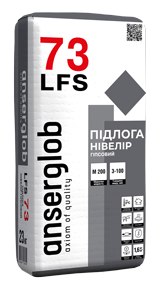
Floor leveling compound ANSERGLOB LFS 73 gypsum-based is intended for primary pouring and leveling of non-deformable mineral substrates, such as concrete (minimum 3 months old, moisture content ≤ 4%), cement-sand screeds (minimum 28 days old, moisture content ≤ 4%), and anhydrite-based substrates in commercial and residential premises not subject to intense moisture exposure. Prepared substrates can be used under various floor coverings such as linoleum, carpet, laminate, parquet, ceramic tiles, natural stone, etc. Floor leveling compound ANSERGLOB LFS 73 gypsum-based is used for bonded, separated, or floating underlayment layers, as well as in underfloor heating systems. Floor leveling compound ANSERGLOB LFS 73 gypsum-based is suitable for machine application.
Substrate preparation is carried out according to DSTU-N B A.3.1-23:2013, SNiP 2.03.13-88 and DSTU-N B V.2.6-212:2016. The substrate must be strong, dry, cleaned of dust, dirt, lime, grease, oil-based and emulsion paints. All weak areas must be thoroughly removed. Cement surfaces must be cleaned of cement laitance using a steel brush or sandblasting equipment to improve adhesion of smooth surfaces. Cracks in the substrate must be widened, treated with one of the ANSERGLOB deep-penetrating primers, and sealed with ANSERGLOB LFS 69, ANSERGLOB LFS 70 cement screed, or floor leveling compound ANSERGLOB LFS 73 gypsum-based. Highly absorbent substrates must be treated with one of the ANSERGLOB deep penetration primers before work and allowed to cure for 4 hours. Low-absorbent substrates must be treated with ANSERGLOB EG 62 or ANSERGLOB EG 63 BETON KONTAKT primer and allowed to cure for 3–6 hours. The floor must be separated from contact with load-bearing and enclosing structures by means of an elastic layer (foamed polyethylene, thin expanded polystyrene). If the monolithic floor may be exposed to moisture from below, a separate waterproofing layer must be used across the entire application area; in this case, the minimum thickness of ANSERGLOB LFS 73 must be 35 mm.
Note: Strength of bed must be not less than M 150. Application should be complied at temperature above +5°С and below +30°С. All the mentioned recommendations are effective at temperature of +20°С and air humidity of 60%. Under the other conditions crusting, stiffening and curing time may be changed.
For machine application, the dry mix is mixed in a plastering unit with the water flow set to approx. 0.23 L/kg. For manual application, dry mix must be poured into a container with clean water at a rate of 0.18 – 0.22 L of water per 1 kg of mix (4.14 – 5.06 L of water per 23-kg bag) stirring manually or mechanically using a low speed drill mixer until a homogeneous, lump-free mass of the required consistency is obtained. Allow the mixture to stand for 5 minutes, then remix it, after which it is ready for use within 30 minutes. Excessive water leads to the deterioration of the compound's properties, reduces its strength, and may cause segregation.
Become a reseller
Leave your contact information, we will contact you shortly to discuss cooperation
FORM FOAM

Thank you, the application has been successfully sent!
Our manager will contact you as soon as possible
Thanks, your order has been successfully sent!
Our manager will contact you shortly
I want to work in anserglob