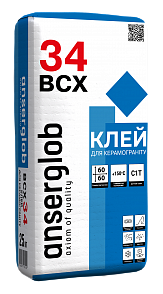
Adhesive ANSERGLOB BCX 34 for porcelain stoneware tiles is intended for facing concrete, brick, cement-sand, cement-lime, and gypsum non-deformable substrates, as well as monolithic floors, with ceramic tiles, concrete tiles and artificial stone, as well as tiles with water absorption less than 1% (porcelain stoneware) with dimensions not exceeding 600x600 mm. For facing of floors with water and electric heating, use tiles with dimensions not exceeding 400x400 mm. The adhesive can be used indoors and outdoors in industrial and residential buildings, on terraces and balconies. It can be applied for use with water and electric underfloor heating systems. Resistant to temperature exposure up to +150°C.
Substrate preparation is carried out according to DSTU-N B A.3.1-23:2013 and DSTU-N B V.2.6-212:2016. The substrate must be strong, cleaned of dust, dirt, lime, oils, grease, wax, oil-based or emulsion paints. Remove unsound sections of the substrate. Surface irregularities up to 10 mm should be leveled with adhesive ANSERGLOB BCX 34. Larger wall irregularities should be leveled with ANSERGLOB BCT 20 plaster mortar, larger floors irregularities with ANSERGLOB LFS 69 or ANSERGLOB LFS 70 cement screed. Highly absorbent substrates must be treated with one of the ANSERGLOB deep penetration primers before work and allowed to dry for 4 hours. Low-absorbent substrates should be treated with ANSERGLOB EG 62 or ANSERGLOB EG 63 BETON KONTAKT primer and allowed to dry for 3–6 hours.
Prepared mortar should be spread by tile trowel, spatula or float on cladding surface. After applied mortar is combed by notch trowel or spatula with the U-shaped notches or square notches, which form equal combs of the same altitude on applied surface. Depending on thickness and dimensions of cladding tiles notch size of trowel is selected (for example, for tile size 33x33 cm trowels with the square notch size 8 mm and more are used). Tiles are installed in turn on the surface, covered by adhesive mortar, and pressed evenly. The tile can be moved during 10 min from the moment of installation if required. Thickness of adhesive layer between tile and substrate must be minimally 2 mm to show its full curing. Using handmade tile with unleveled back side and some cut ceramic and stone tile additional spreading of adhesive mortar by rectangular trowel on tile back side is required in order to achieve full contact between tile and substrate. Applying of adhesive mortar on back side of tile is additional measure and does not replace its spreading on the substrate. Joint width between tiles must be not less than 1,5 mm.
Tiles are prohibited to wet preliminary!
Note: Application should be complied at temperature above +5°С and below +30°С. All the mentioned recommendations are effective at temperature of +20°С and air humidity of 60%. Under the other conditions crusting, stiffening and curing time may be changed.
Average consumption of the mixture is 1,3 kg per m2 on 1 mm of layer.
Dry mixture must be poured into container with clear water according to ratio 0,20-0,22 liters of water per 1 kg of mixture (5,0-5,5 liters of water per 1 bag of 25 kg) when at the same time manually or mechanically mixed (by the drill on low revs) to obtain the kindred and elastic mass. After exposing 5 min mortar must be mixed again and used during 2 hours.